

close
Choose Your Site
Global
Social Media


Views: 0 Author: Site Editor Publish Time: 2026-06-03 Origin: Site


Upgrading traditional activated sludge processes is no longer optional. Aging infrastructure plagues many municipal wastewater treatment plants today. Strict discharge regulations demand higher effluent quality. Severely limited land availability further complicates expansion efforts. You face a critical challenge. Relying on outdated clarifiers leads to inconsistent results.
The core of this transition is the membrane bioreactor system. It relies heavily on advanced filtration materials. We break down the technical functions of these systems here. You will discover how to evaluate different configuration options. We also cover the operational realities of managing them. Strategic procurement guidelines ensure long-term reliability. By following this guide, you will understand how to properly integrate membrane technology into your aging facilities.
Absolute Physical Barrier: High-quality MBR membrane rolls (typically Ultrafiltration) eliminate the need for secondary clarifiers, ensuring consistent effluent quality regardless of peak hydraulic shock loads.
Space-to-Capacity Ratio: Upgrading to MBR systems allows municipalities to significantly increase treatment throughput within the existing plant footprint.
Operational Trade-offs: While capital expenditure (CapEx) can be offset by reduced concrete infrastructure, operating expenses (OpEx) demand strict management of membrane fouling and aeration energy.
Pre-treatment Dependency: The lifespan of any MBR membrane roll is inextricably linked to mandatory upstream fine screening (1–3mm) to prevent physical abrasion and debris damage.
We must define the core component first. The MBR membrane roll serves as the foundational polymeric material. Manufacturers often use PVDF or PTFE polymers to create it. They process these rolls into flat sheets or hollow fibers. It acts as a definitive physical barrier. It strictly separates mixed liquor suspended solids from treated effluent. You rely on it for absolute filtration.
Let us compare pore size and filtration mechanics. Engineers typically prefer Ultrafiltration (UF) over Microfiltration (MF) in municipal settings. UF membranes possess significantly smaller pore sizes. This prevents internal pore clogging inside the material matrix. They reliably reject colloids, harmful bacteria, and most viruses. MF membranes often struggle to achieve this same consistent rejection rate.
Biomass retention fundamentally changes how we operate biological processes. The membrane completely retains all active biomass inside the tank. We can operate plants at remarkably high mixed liquor concentrations. You typically see ranges between 8,000 and 12,000 mg/L. Conventional activated sludge systems rarely exceed 3,000 mg/L. This difference effectively decouples the sludge retention time from the hydraulic retention time.
Membrane Type | Pore Size Range | Internal Clogging Risk | Pathogen Rejection |
|---|---|---|---|
Ultrafiltration (UF) | 0.01 - 0.05 µm | Very Low | Excellent (Viruses and Bacteria) |
Microfiltration (MF) | 0.1 - 0.4 µm | Moderate | Good (Bacteria, poor for Viruses) |
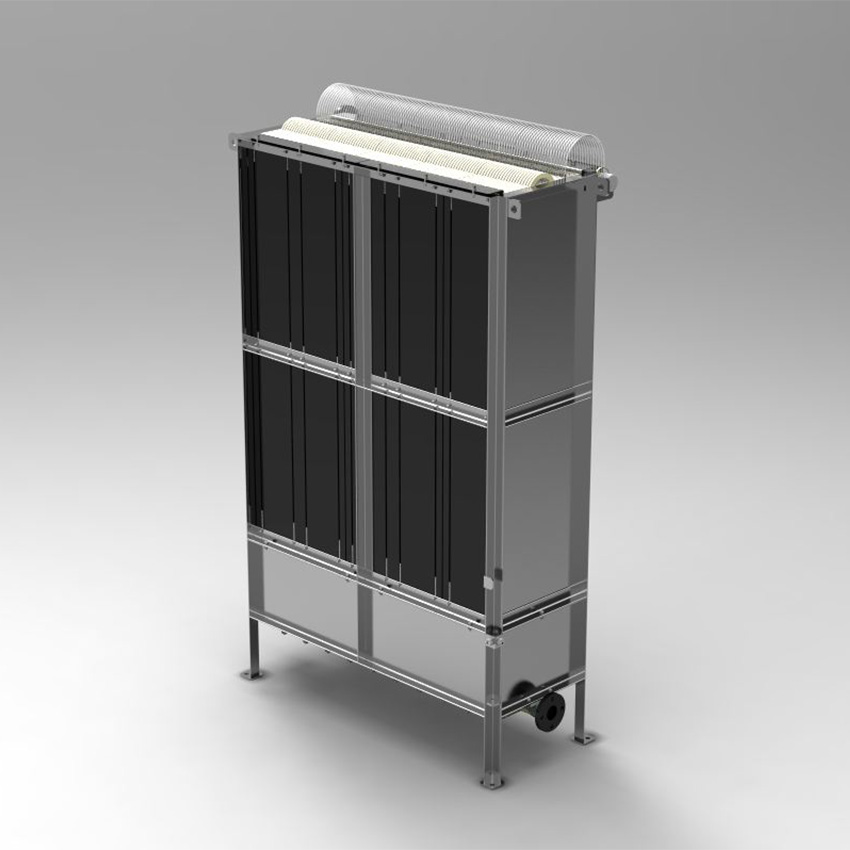
Geometric architecture directly dictates physical resilience. Municipal plants rely heavily on flat sheet or hollow fiber modules. You should rarely consider spiral-wound membranes for these environments. They remain highly sensitive to suspended solids.
Why do flat sheet panels excel in high-fouling environments? Municipal influent contains tremendous amounts of fibrous debris. A properly integrated flat sheet MBR membrane for wastewater treatment offers superior resilience. It easily handles gross solids. It resists hair accumulation, commonly known as ragging. Tightly packed hollow fibers often trap these materials permanently.
Hydrodynamic cleaning mechanisms favor flat configurations. Flat sheet panels maintain a rigid, uniform structure. They allow highly consistent air scouring across the entire membrane surface. Rising air bubbles continuously strip away accumulated bio-cake layers. They do this without tangling any structural fibers.
Implementation risks require careful physical planning. Flat sheet configurations usually demand a slightly larger footprint. You must calculate tank geometries precisely. They provide unmatched durability, but you must accommodate their structural frame.
Immunity to fiber braiding and ragging.
Even distribution of scouring air bubbles.
Simpler module inspection and replacement procedures.
Extended intervals between chemical recovery cleans.
Synergy with downstream disinfection is a massive advantage. Effluent from membrane bioreactors shows near-zero turbidity. Total suspended solids remain exceptionally low. This physical clarity maximizes ultraviolet transmittance. You create a highly efficient synergy with ultraviolet disinfection systems. They use far less energy to neutralize remaining pathogens.
Nutrient and micropollutant removal are critical today. A flat sheet MBR membrane for wastewater reuse actively supports advanced biological nutrient removal. You run the biological process using an extended sludge age. This environment fosters slow-growing nitrifying bacteria. You ensure stringent ammonia and total nitrogen compliance.
We must future-proof infrastructure for water scarcity. Urban centers increasingly mandate non-potable reuse applications. They supply irrigation networks and industrial cooling towers. Some regions even pursue indirect potable reuse. The physical barrier acts as an indispensable pre-treatment step. It protects downstream Reverse Osmosis units. It completely prevents biological fouling on delicate RO surfaces.
When designing for wastewater reuse, always pair your MBR effluent directly with UV disinfection. You eliminate chlorine usage and stop harmful disinfection byproducts from forming.
We must address a common industry misconception right now. Claims of "fouling-free" membranes are scientifically inaccurate. Evaluation must focus strictly on fouling management. You cannot achieve absolute fouling prevention in wastewater.
Monitoring the transmembrane pressure curve is mandatory. System operators track three distinct stages of TMP progression. First comes the initial conditioning phase. Second is a slow, steady linear rise. Third is a sudden exponential jump. You must initiate chemical intervention before the third stage hits. You risk permanent permeability loss if you wait.
Categorizing foulants helps us target cleaning strategies:
Biofoulants and Organics: Extracellular polymeric substances represent the biggest threat. Soluble microbial products also persist stubbornly. Extreme food-to-mass ratios trigger excess organic release.
Inorganics: Calcium and magnesium precipitation occurs frequently. They cause irreversible scaling if ignored. You manage this through routine chemical cleaning-in-place using mild acids.
We face a constant energy trade-off here. Mitigating fouling requires continuous coarse-bubble aeration. We call this process air scouring. You supplement it using intermittent relaxation periods. Sometimes you use back-pulsing for a few minutes hourly. This aeration drives the majority of the system's energy consumption. You must optimize blower speeds to maintain efficiency.
Operators often increase aeration beyond design limits to stop TMP spikes. This shears the biological floc, releasing more organics and worsening the overall fouling condition.
We focus heavily on physical planning and infrastructure needs. The modules themselves require precise tank dimensions. MBRs eliminate the need to construct large secondary clarifiers. You also bypass tertiary sand filters entirely. This spatial efficiency makes retrofits highly attractive for constrained sites.
Mandatory infrastructure prerequisites cannot be ignored. Procurement must include upstream fine screening. You typically install 1–2mm perforated plate screens. Neglecting this screening is a fatal engineering error. It causes premature physical failure of the filtration barrier. Sharp debris slices through polymeric layers rapidly.
Handling peak flows requires distinct design considerations. System design must incorporate upstream equalization basins. You cannot physically push unlimited water through these barriers. They are strictly flux-limited. We typically cap maximum design flux at 1.5 to 2.0 times the average flow. Exceeding this boundary invites severe fouling risks. You must buffer storm events in separate tanks.
Sludge disposal physics change significantly. Extended sludge retention times alter the biological yield. You achieve much higher solids concentrations inside the reactor. This combination directly reduces overall sludge yield volume. You generate fewer cubic meters of waste. Municipal hauling logistics become much easier to manage.
For municipal engineers and procurement teams, selecting the right configuration remains a calculated balance. It balances operational risk with environmental reward. The technology absolutely mandates rigorous physical pre-treatment. It also carries a higher energy baseline for air scouring. Its ability to deliver uncompromising effluent quality remains unmatched. It does this within a minimal footprint. This makes it the definitive solution for aging facilities. You can navigate strict reuse regulations successfully.
Actionable next steps:
Audit your existing primary treatment and fine screening assets.
Model your historical hydraulic peak flows to size equalization basins.
Compare footprint requirements between flat sheet and hollow fiber modules.
Establish a strict preventative chemical cleaning protocol.
A: With strictly enforced fine screening (1–3mm) and optimized chemical cleaning schedules, high-quality municipal MBR membranes typically last 7 to 10 years before physical degradation or irreversible fouling necessitates replacement.
A: Flat sheet membranes are highly resistant to "ragging" (the braiding of fibrous materials and hair), which is a common failure point in municipal wastewater. They also allow for simpler, more uniform air scouring, making them highly resilient to fluctuating organic loads.
A: MBR physical barriers are flux-limited. While they provide an absolute barrier that prevents mixed liquor washout during peak flows, flows exceeding 1.5x–2x the design average require upstream flow equalization to prevent rapid, exponential TMP spikes and severe membrane fouling.


